Installer training
CAD-150 training, from first cable to user handover.
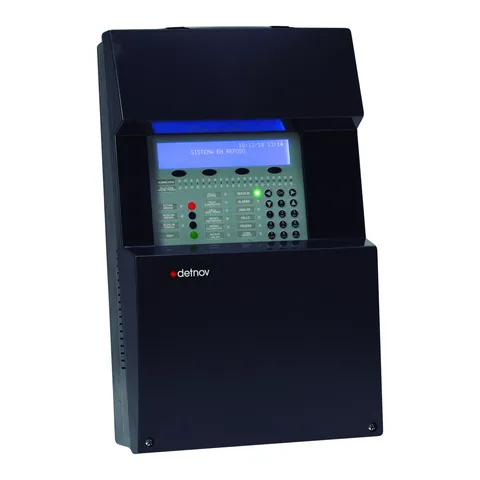
A one-day course for installation technicians. You learn the Detnov CAD-150 addressable panel in theory, then install, commission, fault-find and hand over a working system on a training rig.
- Length
- 1 day
- Format
- Theory and practical
- Pass mark
- 80%
- Framework
- SANS 10139:2021
What you'll be able to do
By the end of the day you can take a CAD-150 installation from first connection to a documented handover.
-
01
Interpret the job
Read the approved design, system category, device schedule and cause-and-effect before touching the panel.
-
02
Install the CAD-150
Identify the panel terminals, build a closed loop, connect supervised outputs and power the panel safely.
-
03
Configure from the front panel
Enter installer access, set the general data, run LOOP AUTOSEARCH, set up zones and points, and prove each point.
-
04
Commission the system
Test alarms, faults, outputs, manoeuvres, sounders and the event log against the approved design.
-
05
Explain it to the user
Show normal, alarm, fault, silence, reset, disablement and test indications, and the site response procedure.
-
06
Hand over correctly
Leave the panel in normal condition, deliver the as-fitted information and explain maintenance responsibilities.
Competence means safe installation, correct configuration, a successful end-to-end test and a clear user handover.
The job flow you'll repeat on the rig
- 1Design
- 2Install
- 3Connect
- 4Power
- 5Configure
- 6Prove
- 7Instruct
- 8Hand over
The day
Six and a half hours of technical content. Theory in the morning, then hands-on work on a CAD-150 for the afternoon.
-
Theory
SANS 10139 context
Design, install, commission, hand over
-
Theory
CAD-150 theory
Panel, loops, devices, outputs and addressing
-
Theory
Connections
Power, loop, sounders, relays and auxiliaries
-
Theory
Front-panel setup
Installer access, AUTOSEARCH, zones and points
-
Theory
Cause and effect
Manoeuvres, testing, records and the role of SCD-150
-
Practical
Practical build
Wire, power, search, configure and test
-
Practical
Fault finding
Open loop, short circuit, missing and wrong device drills
-
Practical
User handover and assessment
Role play, sign-off and final restoration
Practical
Commission a real system to a design brief
Each delegate works on a CAD-150 training rig: one loop with a smoke detector, heat detector, call point, input module and addressable sounder, plus a supervised sounder line and alarm and fault relay lamps.
The brief says what the system must do. Any fire signal must raise the panel alarm, SN1 and the loop sounder, and a fault must operate the fault relay. You build it, prove it and then explain it to the "user".
Nine practical stations
- 1Pre-install review and panel identification
- 2Build and verify the loop
- 3Connect outputs and power up
- 4Installer access and LOOP AUTOSEARCH
- 5Zones, point text and point verification
- 6Create and prove one manoeuvre
- 7Controlled alarm test
- 8Fault-finding drill
- 9User handover instruction
Every station feeds the next one. A fault introduced early has to be found before you can carry on.
Assessment
You pass by showing you understand the system and can work on it safely. A high theory mark can't make up for unsafe practical work.
Theory
Ten written questions on SANS 10139 roles, the power-up order, AUTOSEARCH, manoeuvres, and the difference between silencing the buzzer and silencing the sounders.
Practical
From reading the design brief to finding an injected fault, restoring the panel to normal and giving the user handover, with as little prompting as possible.
Critical fails
- Electrical safety Unsafe live work, ignoring isolation or connecting batteries incorrectly.
- System integrity Leaving wiring insecure, or hiding a fault or disablement.
- Commissioning Accepting missing or wrong devices, or not proving the programmed response.
- Restoration Leaving the panel in test, disablement, fault or alarm.
- User instruction Telling the user to power down, reset unexplained alarms, or confusing buzzer and sounder silence.
"Not yet competent" means you retrain and are reassessed on the step you missed.
Book a place
Tell us who needs training and when suits you. We'll come back to you with the next available date, the venue and the price.
Need help on a live job?
Our technical team helps with commissioning, programming and fault finding on Detnov systems.